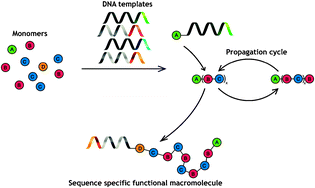
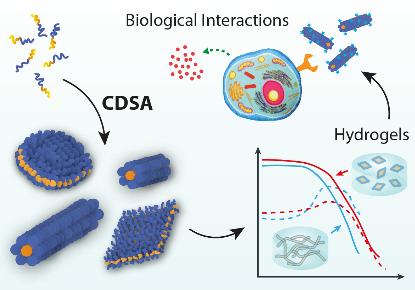
Previous Research Areas
Polymerisation-Induced Self Assembly (PISA)
Polymerisation-induced self-assembly (PISA) facilitates the preparation of polymer nanoparticles at high concentrations and/or in the presence of biomacromolecules. Our interests in this area are to understand structure-property relationships between block copolymer polymerisation kinetics/mechanism on assembly morphology and to apply these learnings to the formulation of enzyme- or drug-loaded nanoparticles for applications in medicine. In so doing, we have elucidated the role of hydrophobicity in block copolymer self-assembly, applied new polymerisation strategies to PISA, discovered novel pathways of morphological evolution, and revealed the role of nanoparticle permeability on enzymatically-catalysed reactions within polymeric nanoreactors, amongst other advances.
Ring-Opening Metathesis Polymerisation Induced Self-Assembly
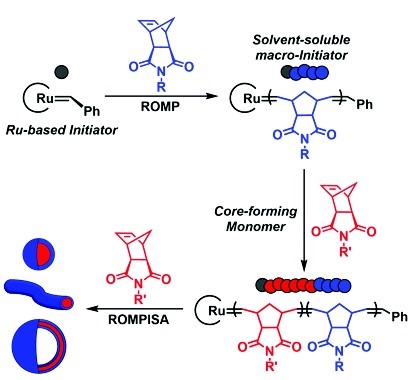
We have developed methodology to conduct aqueous ring-opening metathesis polymerisation (ROMPISA) using commercially available Ru-based catalysts. In addition to providing access to polymer amphiphiles with unique backbone and sidechain chemistries, our work on ROMPISA has revealed exceptional self-assembly behaviour with respect to morphology and morphological evolution. Recent studies have focused on the optimisation of ROMPISA under neutral conditions, the formation of tubular polymersomes (tubesomes) during polymerisation as the result of polymersome fusion, and on the permeability of polymersome membranes synthesised by ROMPISA. We are excited about the possibilities that ROMPISA offers as an alternative methodology to PISA using RAFT polymerisation.
It’s better with salt: Aqueous Ring-Opening Metathesis Polymerization at Neutral pH, J. C. Foster; M. C. Grocott; L. A. Arkinstall; S, Varlas; M. J. Redding; S. M. Grayson; R. K. O’Reilly, J. Am. Chem. Soc. 2020, DOI: 10.1021/jacs.0c05499
Ring-Opening Metathesis Polymerization-Induced Self-Assembly (ROMPISA), S. Varlas; J. C. Foster; R. K. O’Reilly, Chem. Commun. 2019, 55, 9066-9071, DOI: 10.1039/C9CC04445K
Polymerization-Induced Polymersome Fusion, S. Varlas; R. Keogh; Y. Xie; S. L. Horswell; J. C. Foster; R. K. O’Reilly, J. Am. Chem. Soc., 2019, 141, 51, 20234-20248; DOI: 10.1021/jacs.9b10152
Enzyme Loaded Nanoreactors
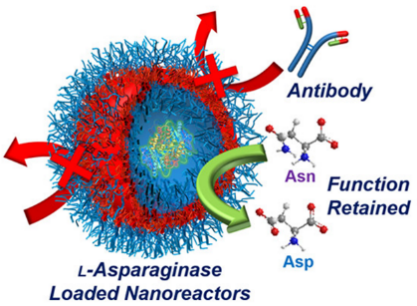
Polymer nanoreactors are generally comprised of polymer micelles or polymersomes that have been functionalised or loaded with catalytic moieties. Due to the mild reaction conditions required for PISA when using photo-mediated RAFT polymerisation, enyzmes and other sensitive biological cargos can be readily encapsulated within polymersomes. Entrapment of enzymes such as horseradish peroxidase (HRP) or glucose oxidase (GOx) within polymersomes protects them from degradation by external forces (i.e., proteases) and allows for triggered or selective catalysis via manipulation of polymersome membrane chemistry. Our group has pioneered the formulation of enzyme-loaded nanoreactors, demonstrated the advantages of enzyme encapsulation in cascade reactions, and studied the selectivity of polymersome membranes for enzyme substrates. The ultimate aim of this research is to develop cellular mimetic particles for future therapeutic applications.
Confinement of Therapeutic Enzymes in Selectively Permeable Polymer Vesicles by Polymerization-Induced Self-Assembly (PISA) Reduces Antibody Binding and Proteolytic Susceptibility; L. D. Blackman, S. Varlas, M. C. Arno, Z. H. Houston, N. L. Fletcher, K. J. Thurecht, M. Hasan, M. I. Gibson and R. K. O’Reilly, ACS Cent. Sci., 2018, 4, 718-723, DOI:10.1021/acscentsci.8b00168
Tuning the membrane permeability of polymersome nanoreactors developed by aqueous emulsion polymerization-induced self-assembly, S. Varlas, J. C. Foster, P. G. Georgiou, R. Keogh, J. T. Husband, D. S. Williams and R. K. O’Reilly, Nanoscale, 2019, 11, 12643-12654, DOI: 10.1039/C9NR02507C
Photoinitiated Polymerization-Induced Self-Assembly in the Presence of Surfactants Enables Membrane Protein Incorporation into Vesicles, S. Varlas, L. D. Blackman, H. E. Findlay, E. Reading, P. J. Booth, M. I. Gibson, R. K. O’Reilly, Macromolecules, 2018, 51, 6190-6201, DOI: 10.1021/acs.macromol.8b00994
PISA Structure-Property Relationships
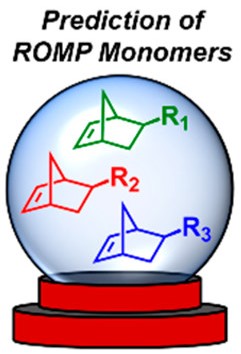
Our group, in collaboration with the late Prof. Robert Mathers at Penn State University, developed computational and predictive methodologies for identifying monomers to be used to synthesise core-forming blocks during PISA. Our efforts in this area have focused on PISA using both RAFT polymerisation and ROMP. In addition to identifying novel monomer structures, this methodology has been used to explain PISA phenomena such as nanoparticle nucleation, morphological evolution, and nanoparticle phase behaviour.
We have also rigorously investigated the impacts of polymerisation conditions (i.e., initiation method, the presence/absence of surfactant, end group structure, etc.) on the morphologies obtained during PISA when using RAFT polymerisation. These learnings have enabled research in the areas of enzyme-loaded nanoreactors, drug delivery vehicles, and industrial formulations.
Getting into Shape: Reflections on a New Generation of Cylindrical Nanostructures Self-Assembly using Polymer Building Blocks, J.C. Foster, S. Varlas, Benoit C. Couturaud, Z. Coe, R.K. O’Reilly, J. Am. Chem. Soc, 2019, 141, 2742–2753, DOI: 10.1021/jacs.8b08648
Predicting Monomers for Use in Aqueous Ring-Opening Metathesis Polymerization-Induced Self-Assembly, S. Varlas, J. C. Foster, L. A. Arkinstall, J. R. Jones, R. Keogh, R. T. Mathers and R. K. O’Reilly, ACS Macro. Lett., 2019, 8, 466–472, DOI:10.1021/acsmacrolett.9b00117
Predicting Monomers for use in Polymerization Induced Self‐Assembly, J. C. Foster, S. Varlas, B. Couturaud, J. Jones, R. Keogh, R. T. Mathers, R. K. O’Reilly, Angew. Chem. Int. Ed., 2018, 57, 15733–15737, DOI: 10.1002/anie.201809614
Responsive Nanoparticles
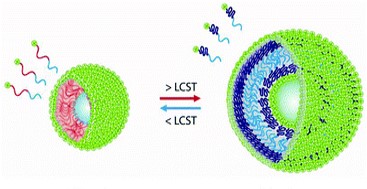
Responsive nanoparticles are capable of altering their physical and/or chemical properties following exposure to an external stimulus. These sophisticated structures have received a great deal of attention in recent years as scientists seek to develop functional systems that respond to changes in their microenvironment, exhibiting behaviour which mimics that of living organisms. To date, a variety of systems have been reported which respond to changes in pH, temperature, mechanical force, the presence of various small molecules and biomolecules, and electric/magnetic fields.
These systems have found use in a variety of applications from sensors and biosensors, for controlled and triggered drug delivery, environmental remediation and chemo-mechanical actuators, amongst others.
Within the O’Reilly group we seek to utilise our expertise in polymer synthesis and self-assembly for the design of responsive polymeric structures. We are particularly interested in how the exhibited response can be tuned to change the function, size or morphology of the construct, to allow for their application in a wide range of settings, including as delivery vehicles or sensors. At present, we have a number of projects in this research area including:
Developing a fundamental understanding of temperature-responsive nanostructures
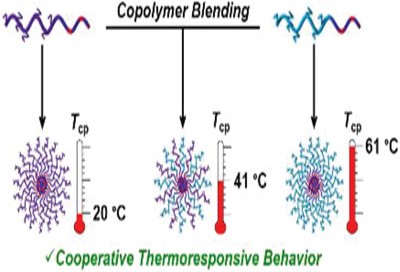
Much of the work within the group on responsive nanoparticles has focussed on developing a fundamental understanding of systems which exhibit thermoresponsive behaviour. This ranges from the development of new monomer structures for the synthesis of thermoresponsive polymers, to better understanding the factors that influence thermoresponsive behaviour in self-assembled constructs. This includes investigations into using thermoresponsive triggers to induce self-assembly or morphological changes, studies into how molecular weight, branching effects, grafting density, or aggregation number (Nagg) influence factors such as lower/upper critical solution temperatures or thermal hysteresis, and using copolymer blending or copolymerisation to tune the thermoresponsive behaviour.
To Aggregate, or not to Aggregate? Considerations in the Design and Application of Polymeric Thermally-Responsive Nanoparticles, M. I. Gibson and R. K. O’Reilly, Chem. Soc. Rev. 2013, 42, 7204-7213, DOI: 10.1039/C3CS60035A
The Importance of Cooperativity in Polymer Blending: Toward Controlling the Thermoresponsive Behavior of Blended Block Copolymer Micelles, R. Keogh, L. D. Blackman, J. C. Foster, S. Varlas, R. K. O’Reilly, Macromol. Rapid Commun., 2020, 41, 1900599-1900604, DOI: 10.1002/marc.201900599
Grafting Density Governs the Thermoresponsive Behavior of P(OEGMA-co-RMA) Statistical Copolymers, I. Akar, R. Keogh, L. D. Blackman, J. C. Foster, R. T. Mathers, and R. K. O’Reilly, ACS Macro Lett., 2020, 9, 1149–1154, DOI: 10.1021/acsmacrolett.0c00461
Utilising thermoresponsive polymeric structures as catalytic nanoreactors

Extending our understanding of these thermoresponsive polymeric constructs, we have also reported a number of examples utilising the unique self-assembly of thermoresponsive polymers for use as latent catalytic nanoreactors. This has been achieved by using the thermoresponsive behaviour to induce self-assembly, by either triggering a change in hydrophobicity or inducing cross-linking between polymer chains. This, in turn, generates a hydrophobic domain that can be utilised for a range of catalytic processes, ranging from the L-proline catalysed asymmetric aldol reaction to the N-heterocyclic carbene (NHC) mediated benzoin condensation. In many cases, the reversible nature of the thermoresponse can be further utilised to aid recovery and reuse of these catalytic systems, with minimal loss of catalytic activity typically observed.
Recyclable l-Proline Functional Nanoreactors with Temperature-Tuned Activity Based on CoreShell Nanogels, A. Lu, D. Moatsou, I. Hands-Portman, D.A. Longbottom, R.K. O’Reilly, ACS Macro Letters, 2014, 3, 1235-1239, DOI: 10.1021/mz500704y
Reversible Ionically-crosslinked Single Chain Nanoparticles as Bioinspired and Recyclable Nanoreactors for N-Heterocyclic Carbene Organocatalysis, S. Garmendia, A. P. Dove, D. Taton, R. K. O’Reilly, Polym. Chem, 2018, 2018, 9, 5286, DOI: 10.1039/C8PY01293H
Catalytically Active N‐Heterocyclic Carbene Release from Single‐Chain Nanoparticles Following a Thermolysis‐Driven Unfolding Strategy, S. G, Garmendia, S. B. Lawrenson, M. C. Arno, R. K. O’Reilly, D. Taton and A. P. Dove, Macromol. Rapid Commun, 2019, 40, 15, 1900071, DOI:10.1002/marc.201900071
Designing and synthesising new responsive constructs
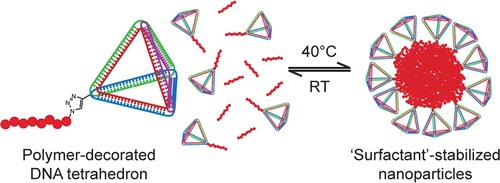
Finally, we have also been interested in utilising responsive behaviour to create unique and interesting constructs that respond to not just temperature, but also changes in hydrogen bonding, salt concentration, pH and/or CO2. Utilising the reversible nature of these responses it is possible to design systems where a change in morphology or material property can be used for applications ranging from sensing to controlled delivery. This work covers a broad range of topics, but some interesting examples from the group include a fluorescent nanogel which swells when exposed to CO2¸ meaning the fluorescence behaviour can be used as a simple but effective CO2 sensor, or a self-assembled diblock copolymer system which forms micelles at acidic pH and vesicles at basic pH, thus allowing for the triggered and controlled release of a hydrophobic dye molecule.
‘Giant Surfactants’ Created by the Fast and Efficient Functionalization of a DNA Tetrahedron with a Temperature-Responsive Polymer, T. Wilks, J. Bath, Jan de Vries, J. Raymond, A. Herrmann, A.J. Turberfield, R.K. O’Reilly, ACS Nano, 2013, 7, 8561-8572, DOI:10.1021/nn402642a
Block Copolymers: Controlling Nanostructure to Generate Functional Materials – Synthesis, Characterization, and Engineering, T.H. Epps III, R. K. O’Reilly, Chem. Sci. 2016, 7, 1674-1689, DOI: 10.1039/C5SC03505H
CO2/pH-responsive particles with built-in fluorescence read-out, A. B. Mabire, Q. Brouard, A. Pitto-Barry, R. J. Williams, H. Willcock, N. Kirby, E. Chapman, R. K. O’Reilly, Polym. Chem., 2016, 7, 5943, DOI: 10.1039/C6PY01254J